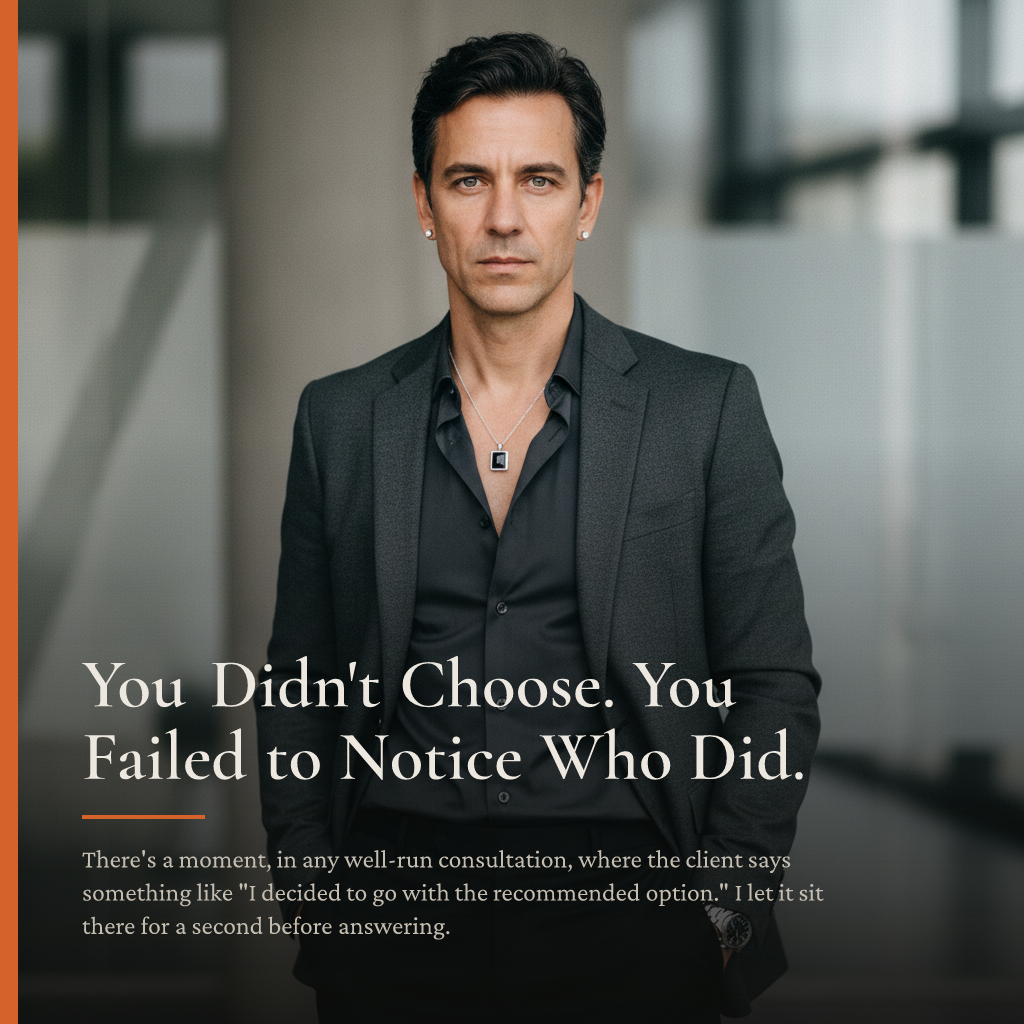
There's a moment, in any well-run consultation, where the client says something like "I decided to go with the recommended option." I let it sit there for a second before answering. That sentence is doing more work than they realize. They didn't decide. They noticed the option already selected for them, felt no resistance to it, and called the absence of resistance a choice.
This isn't an accusation. It's a mechanism. Mechanisms are worth naming precisely because they run without anyone's permission.
The mechanism runs without anyone's permission
Here's the structure. It's cleaner than most people want it to be. When a system presents you with a default — the box already checked, the plan already selected, the tier already highlighted — you arrive at your final action one of two ways. Either you actively override the default and choose something else, in which case the sense of agency is unambiguous. Or you let the default stand, and something quieter happens: your mind, needing to explain your own behavior to itself, looks for the cause. Absent a visible hand forcing you, it assigns the cause to you. Not because you exercised judgment. Because judgment is the only candidate left standing once coercion isn't obviously present.
A large study measured the feeling, not the fact
A large experimental study published in Behavioural Public Policy found exactly this, and the interesting part never makes the headline. Researchers gave participants a prosocial opt-out default — a nudge built to produce a specific, socially desirable outcome — and compared their behavior and self-reported experience against participants who chose the same outcome through active opt-in. The sample was substantial: N=2083. The result that gets quoted everywhere is that the nudged group made more prosocial choices. Fine. Expected. That's what a well-built default does.
The result that gets buried is the one that matters. The nudged participants did not report lower autonomy. They did not report lower satisfaction with their choice, compared to the opt-in group. On paper, that reads as vindication for the architects of the nudge. Look, no harm done. The person felt just as free.
Sit with that finding a second longer than the researchers' summary invites you to. Feeling free and being free are not the same variable. An experiment that measures the feeling has told you nothing about the fact. The authors know this. It's why they flagged their own result as a trap. They call it, carefully, an autonomy bias — the tendency to rate your own autonomy as high specifically because you lack strong evidence to the contrary, not because the evidence for it is strong. The absence of a visible puppeteer gets misread as the absence of any puppeteer at all.
People pay for the choosing, not the outcome
This is where a second study earns its place next to the first, because it answers a question the default-satisfaction data can't answer. If autonomy were only instrumental, valuable to people solely as a tool for maximizing outcomes, then a default that produces a good outcome should fully substitute for the freedom to choose it yourself. No residual value should remain unaccounted for. A 2026 study in the Journal of Public Economics, running two large-scale online experiments with a combined sample of N=1422, tested something more precise: not whether people report feeling autonomous, but what they're willing to pay for autonomy itself, independent of the outcome it produces. The willingness to pay for choice autonomy was significantly greater than zero on average. People pay for the act of choosing. Not for a better result. For the choosing.
Put these two findings next to each other and the shape of the thing becomes visible. One study shows that removing the choice doesn't reduce the reported feeling of freedom. The other shows that the feeling of freedom, when genuinely present, carries measurable economic value to the person experiencing it. The nudge isn't neutral. It isn't harmlessly swapping in a good outcome for free. It's quietly withholding something the subject would have paid for, while leaving behind a feeling convincing enough to stand in for the thing itself.
I've watched this exact substitution happen in rooms that have nothing to do with behavioral economics. In ownership structures. In advisory arrangements. In the fine print of who actually holds the decision rights on an asset someone believes they control. The mechanism is identical. Remove the visible hand, leave the outcome intact, and the person downstream will construct their own agency to fill the vacuum. Not because they're careless. Because the mind prefers a story where it authored the outcome over a story where it was managed into one, and absent a hand actively forcing the alternative, that preference wins by default.
Being managed and choosing look identical from inside
The distinction that actually matters here isn't between good defaults and bad ones. Plenty of defaults produce outcomes worth wanting. The distinction is between a person who chose and a person who was correctly positioned to believe they chose. From the inside, the two are indistinguishable. That's not a flaw in the research. That's the finding. The bias doesn't announce itself, because an announced bias would trigger the resistance it depends on not triggering.
What stays with me isn't the behavioral science. It's the shape it rhymes with everywhere else. The portfolio someone believes they built through their own judgment, when the structure was set by whoever controlled the defaults on the term sheet. The board seat someone believes they earned, when the seating chart was decided before the vote was ever taken. Autonomy bias isn't a lab artifact. It's the standing condition of anyone who has never had reason to check whether the hand was there.
You don't need a villain for this to work. You need an absence. No visible coercion, no dissenting evidence, no reason to look closer. The system doesn't have to hide the default. It only has to make sure you never feel the specific discomfort of being managed.
Comfort is the tell. Not the presence of a hand guiding you, but the complete, undisturbed sense that no hand was needed at all.
— Lucien Sael · Builder, Thinker, Operator