For a century, the working theory held that habits accumulate. Repeat an action enough times and something inside the organism gradually converts effort into automation — a slope, not a step. It's an intuitive model. It matches how habit formation is marketed, taught, and sold: consistency as deposit, automaticity as interest earned. Nobody had actually watched the transition happen, though. Not at the level of the system that governs it. Someone finally did.
A team at Johns Hopkins, led by Kishore V. Kuchibhotla with Sharlen Moore as first author, published findings in Nature Communications that, as I read them, dismantle the slope. Animals trained on a discrimination task learned to tell the difference between options almost immediately, and that part stabilized fast. What the researchers tracked next is, to me, the part that matters. The behavioral system governing whether an action stayed goal-directed or slid into habit kept fluctuating for a long stretch after the discrimination itself had already settled. The animal knew the task. The system deciding how to relate to the task hadn't decided anything yet.
The switch has a measured location
Then it did. Not slowly.
Using HMM-GLM modeling, a statistical method built to detect hidden state changes inside sequential behavior, the team located the switch at approximately 3 trials. I read it in Nature Communications. Before that point: fluctuation, a system still weighing whether this behavior deserved deliberate attention. After it: habit, confirmed by four converging measures — sensory-specific outcome devaluation, lesions in the dorsolateral striatum, motor stereotypy, and pupillary response. Four independent readouts, one shared moment. The system didn't ease into automation. It crossed a line.
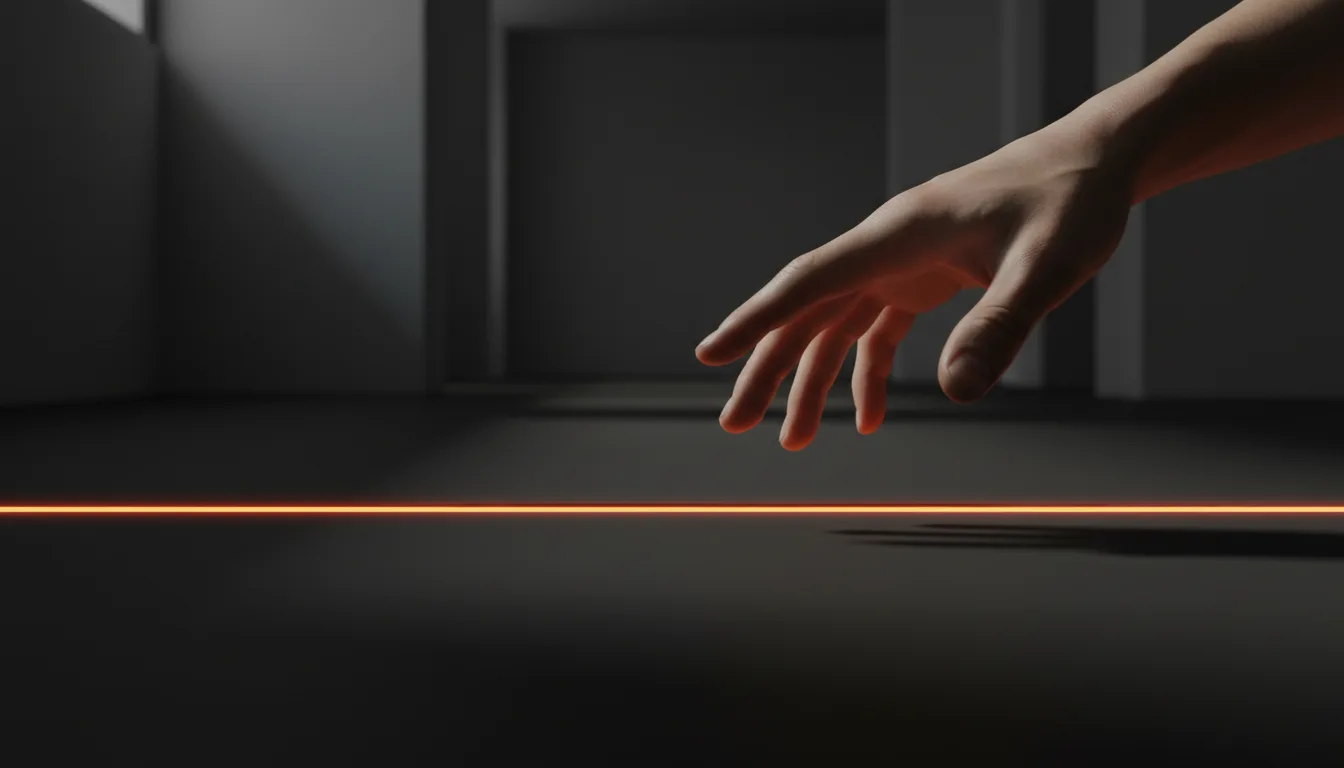
A later analysis I read in Silicon Canals sharpened this in June 2026: the discovery isn't that habits form faster than believed. It's that habit formation was never a gradient to begin with. It's a threshold event, binary, not cumulative. The animal wasn't 40% habituated on day six and 70% habituated on day twelve. It was in one state, then it was in the other, and the space between them was a handful of trials, not weeks.
The slope model is what keeps people waiting
Here is where most people stop reading and file this under neuroscience trivia. That's the mistake.
This finding is not about mice. It's about the entire mental model most humans carry regarding their own behavior — the belief that repetition is deposit-making, that the fortieth rep is meaningfully closer to automatic than the fifth. That belief lets people postpone discipline indefinitely, because if change accumulates slowly, there's always more runway before the deadline. The Johns Hopkins data says otherwise. There is no runway. There is a state you're in, a threshold you haven't crossed, and a small number of trials standing between the two.
Consider what this does to the way people talk about routines. The gym membership. The skincare regimen. The morning ritual sold as a 21-day unlock or a 66-day rewiring, numbers pulled from folk psychology and old habit-loop theory, never from a mechanism this precise. Those numbers were never measuring the threshold. They were measuring how long it takes a person to stop noticing they've already crossed it, which is a different question entirely, and a far less honest one to build a product around.
This is the real reason so much behavioral advice fails on contact with real life. Not because the person lacked willpower. Because the model handed to them was wrong at the level of mechanism. Told that habit accumulates, they treat every lapsed day as erased progress on a slope, and quit, because a slope punishes interruption severely. A threshold model punishes nothing. It says: you are either past the switch or you are not, and the switch is close, and the fluctuation you feel right before it is not failure. It's the system doing exactly what a system does before a state change — deliberating, testing, refusing to commit until commitment is warranted.
The striatum decides who takes custody of behavior
The dorsolateral striatum lesions are the part worth sitting with longest. When that structure was disrupted, the abrupt transition to habitual behavior didn't happen. The animals stayed goal-directed, deliberate, flexible, sensitive to outcome devaluation, because the neural substrate that encodes rigid, automatic execution simply wasn't available to take over. Habit, in other words, isn't the absence of a decision. It's a specific structure taking custody of behavior that used to require one. That's a mechanical claim, not a motivational one. It doesn't ask the organism to try harder. It asks whether the substrate for automation has been engaged yet.
Most consumer routines are built on the opposite premise: that the person must supply willpower until some vague accumulation threshold is crossed, at which point the product's marketing claims the habit "sets in." That framing outsources the hardest part to the user and takes credit for the outcome. A more honest architecture does the reverse. It reduces the number of decisions the goal-directed system has to keep making, so the trials that matter, the ones near the threshold, arrive faster and cleaner, without a long unstable stretch of deliberation in between.
This is the design logic I built into my own routines. Not motivational scaffolding. Not day-count promises. Reducing friction at the exact point where a behavior is deciding what kind of behavior it's going to become. Fewer variables. Fewer reasons for the system to keep fluctuating past the point where fluctuation serves anything.
It's a threshold event, binary, not cumulative.
The old model told people they were climbing. The data says they're standing at a door, and the door doesn't care how long they've been standing there. It cares whether they walk through the next few times it matters. Most people are closer to the switch than they've been told, and further from earning it than they think.
Both things are true. Neither is comfortable.
That's usually a sign the number is real.
— Lucien Sael · Builder, Thinker, Operator