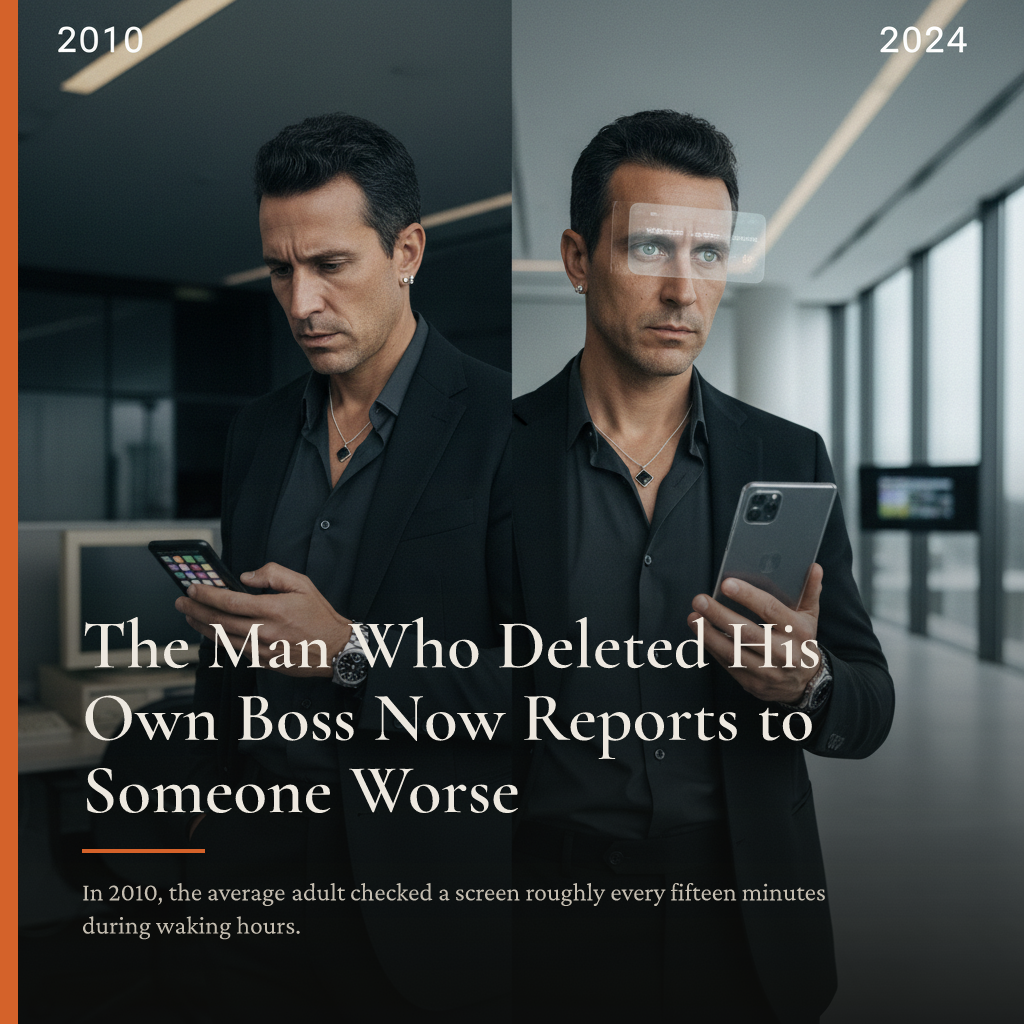
In 2010, the average adult checked a screen roughly every fifteen minutes during waking hours. By 2024, that number hadn't fallen. The devices had simply gotten better at making the checking feel voluntary. No one forces the hand to the phone. That's the entire point. The compulsion arrived dressed as a choice, and the dressing is the mechanism.
Epicurus did the arithmetic and chose less on purpose
Epicurus ran a garden outside Athens and told his students to want less. Not because wanting was shameful. Pleasure was the highest good, he was unambiguous about that. But he'd done the arithmetic and found that unmet desire is itself a form of pain. A man who craves wealth suffers twice: once in the lack, once in the getting, because the getting only relocates the craving to something larger. So the Epicurean program was reduction as strategy. Ataraxia, the untroubled mind. Aponia, the absence of bodily distress. The sage wanted bread, water, and a few friends, and built his entire philosophy around one discovery: this was enough. More was not a superior version of enough. It was a treadmill wearing enough's clothes.
Byung-Chul Han describes a different animal entirely. The difference is everything.
Han's subject became its own warden without noticing
Foucault's subject lived under a disciplinary regime — the factory floor, the barracks, the prison — where power stood outside the self and told it what it could not do. That subject knew its enemy. It could name the foreman, the warden, the drill sergeant. Han's subject has no foreman. It has a dashboard. It has met the enemy and decided the enemy is a personal growth opportunity. This is the subject of performance: the one who no longer needs a boss to demand more output, because it already installed the demand internally and mistook the installation for ambition. It optimizes its sleep. It gamifies its rest. It treats leisure as a category of achievement, then wonders, with genuine confusion, why leisure has stopped working.
Here is the mechanism. It deserves to be walked through slowly, because the confusion is not accidental. It's structural.
The choice felt free because the design made it feel that way
Foucauldian power was visible because it was external. You could point at the wall of the prison. Han's power works by disappearing into the first person. The subject doesn't experience the imperative to optimize as a command from outside. It experiences it as its own idea, its own ambition, its own five-year plan. This is functionally identical to what choice architects call the autonomy bias: the tendency to believe a decision originated with you, even when the environment was engineered to make one option nearly inevitable. The menu had thirty items but only one was lit up, warm, and priced to feel like a discount. You chose it. You're certain you chose it. The certainty is the design working correctly.
So when the subject of performance collapses — and it does collapse, reliably, on a schedule that has produced an entire market in recovery retreats and burnout coaching — it doesn't experience the collapse as oppression. It experiences it as personal failure. There's no warden to blame. There's only the mirror, and the mirror is unhelpful, because the mirror was never the source of the demand. It only reflected a demand manufactured elsewhere and laundered through the language of self-actualization until it became indistinguishable from free will. The subject beats itself for underperforming against a standard it believes it invented. It never did. It inherited the standard the way a man inherits debt he didn't sign for, then spends a decade paying interest on a decision that was never his.
The same architecture, wearing a different costume, shows up in how a generation now searches for a partner.
Dating apps run the same architecture on desire itself
A June essay by the writer known as Lastrevio applies Deleuze and Guattari's *Anti-Oedipus* to dating apps, and the argument lands with unusual precision: neoliberal dating culture demands frictionlessness. The search for love, like the search for a product, isn't supposed to have snags. Swiping is designed the way a checkout page is designed — remove every obstacle between impulse and transaction. Once desire organizes itself around frictionless acquisition, it becomes, in Lastrevio's framing, fetishized in a manner directly analogous to Marx's commodity fetishism. The person on the other end of the match is experienced not as someone with a history and a texture, but as a bundle of attributes competing against an infinite, algorithmically replenished field of alternatives. Deleuze and Guattari called this the replacement of codes by axiomatics. The old, specific, culturally embedded rules for how desire was supposed to move have been swapped for a bare mathematical logic that runs on anything, indifferent to content, exactly the way capital itself runs on anything. A code told you what love should look like. An axiomatic just tells you to keep swiping until the number improves.
Notice what hasn't changed since Epicurus. The problem he diagnosed — that unmet desire produces suffering, and that more options produce more unmet desire, not less — has not been solved by two thousand years of material progress. It's been industrialized. The garden offered fewer choices and more peace. The app offers infinite choices and reports, with something close to pride, an epidemic of app fatigue among its own users. Epicurus wouldn't have called this decadence. He'd have called it exactly what he warned about: the mind trained to mistake motion for satisfaction, running faster toward a horizon that recedes at the same speed it's approached.
It only reflected a demand manufactured elsewhere and laundered through the language of self-actualization until it became indistinguishable from free will.
What the ascetic hedonist understood, and what the performance subject has been engineered to forget, is that the felt sense of choosing is not evidence of having chosen well. A man can select every item on his own plate and still be eating someone else's menu. The dashboard that tracks his sleep, the app that curates his matches, the internalized voice telling him to optimize both — none of these arrived by his invitation, and all of them now speak in his own voice. That's precisely why he can't hear them as foreign. He built the cage from the inside, believing the blueprint was his, and he calls the exhaustion that follows a personal shortcoming rather than what it actually is: the bill for architecture he never signed off on, arriving under a name he trusts completely.
His own.
— Lucien Sael · Builder, Thinker, Operator